
01

CNC Shaping & Precision Generation
CNC machining, contouring and profiling generate the required geometry. The exact method is selected for the material, component shape and drawing requirements.
Controlled machining, grinding, lapping and polishing processes for optical materials, complex geometries and demanding dimensional requirements.
Material behavior, geometry, thickness, edge condition and final optical requirements all influence the manufacturing route. We review these requirements before production to choose a practical process sequence.
A controlled sequence of material removal and finishing steps is selected for the component geometry and final specification.
CNC machining, contouring and profiling generate the required geometry. The exact method is selected for the material, component shape and drawing requirements.
For suitable flat components, double-sided rough grinding removes material efficiently to establish thickness, flatness and parallelism. The workpiece remains matte or opaque at this stage.
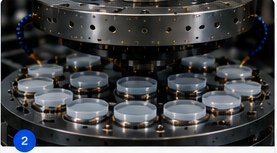
Fine grinding refines dimensional accuracy and surface condition before polishing. COE may use single-side or other controlled grinding routes depending on the product.
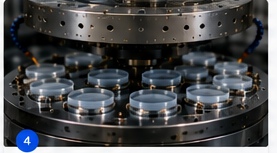
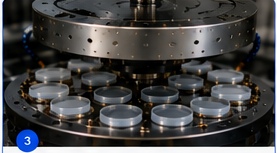
For suitable flat optics, double-sided polishing can produce the final optical surface with excellent flatness, parallelism and low roughness. Other polishing routes are selected when geometry requires.
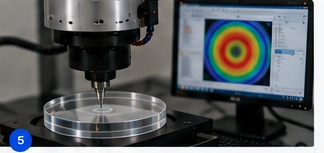
Dimensional and optical measurements verify critical requirements and provide feedback for process control and final inspection.
Windows, lenses, prisms, rods and custom components may use different equipment, intermediate operations and finishing sequences. The stages above describe the general manufacturing logic rather than a fixed production recipe. Different products may use different equipment, intermediate operations and inspection points.
Different optical materials require different tooling, feeds, finishing sequences and handling practices.
Specify the optical material and grade where applicable.
Include overall size, thickness, radii, wedge, chamfers and special features.
Apply tight tolerances only where the optical or mechanical system requires them.
Surface quality, flatness, transmitted wavefront or other optical requirements as needed.
Include coating requirements and expected prototype or production quantity.
Send your drawing and material requirements for engineering review.